My essential shelf web-books
A cherry picked list of books for web designers
The web is a young phenomenon if we compare it to other disciplines. As a young phenomenon, the bibliography around it is also relatively thin but not absent.
Among the millions of lines written on the medium of the internet itself, which is absolutely the best source for quick updating and easily accessing articles and news, we have some old fashion kinds of reading, namely in the form of books, digital or paper books. Yes, the old dear books!
I have been discouraged to read books about coding languages a long time ago. Most of the up-to-date techniques, documentation, and news about code are online, almost the day after are launched.
But when it comes to studies about User experiences or Interaction design, my devotion to proper books comes quickly back. Those books start from page one and end on the page... some hundreds.
The book that illuminates and inspires many UX designers is definitely: The design of everyday things, by Don Norman. This is a milestone for every UX designer. By defining the balance between utility, usability, and beauty of the products we daily use. Don Norman evidences the cognitive skills of a good designer too.
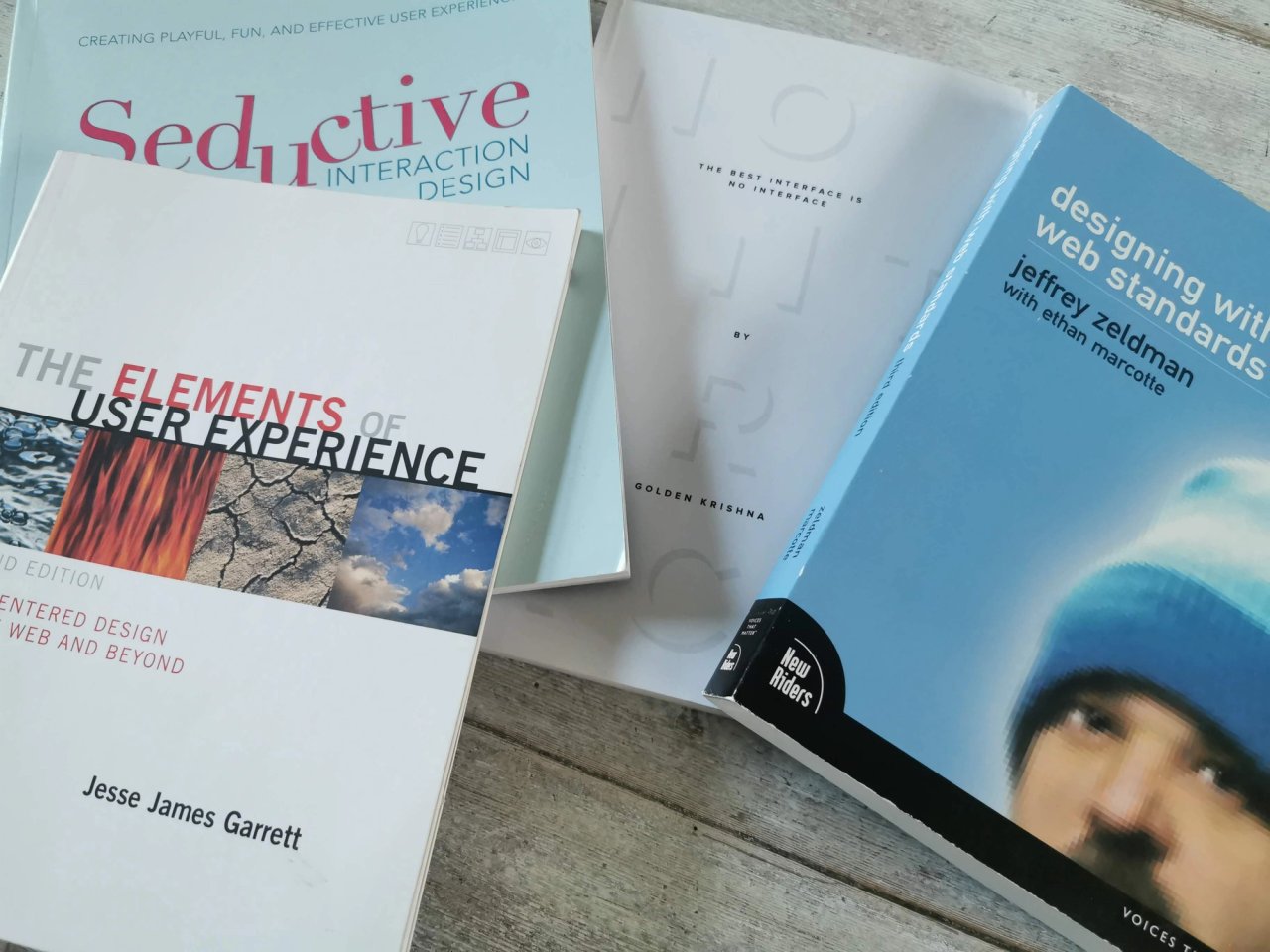
The elements of user experience design, by Jesse James Garret, is a very practical manual on how to conduct the work around digital products. How to divide projects into different stages, in a process from abstract to more and more concrete.
Thinking fast and slow, by Daniel Kahneman. This book explains in a simple and beautiful way two main categories of mental models: slow thinking, a ponderate analysis of the choices made in front of us (and probably digital products), or fast thinking which is dominated by emotions.
The resilient web design, by Jeremy Keith. The author here leads us through the history of web design with a specific point of view: the progressive enhancement of design and coding elements of web pages. By using this technique developers achieve better usability and responsiveness of digital products.
Seductive interaction design, by Stephen P. Anderson, is a book that intends to underline the behaviors of humans and inspire designers on how to use these behaviors to design attractive and functional user interfaces.
The best interface is no interface, by Golden Krishna. The author, a user experience designer working at the moment (2021) at Google, with a dose of humor and concrete examples explains how should be the approach of a user experience designer that designs interaction with systems.
Designing with web standards, by Jeffrey Zeldman. Maybe the most technic of this list of books but also the book where UX designing most mixes with the technical aspects of this job.
Besides reading, my favorite way to keep up to date is Twitter.
People worth following on Twitter are Jen Simmons, a member of the CSS Working Group, who keeps you updated on CSS news. Ethan Marcotte, promoter of responsive design approach techniques. Chris Coyer from CSS Tricks. Brad frost, evangelist of Atomic designing, and design systems. Jeffrey Zeldman and his podcast "The big web show". Harry Roberts, is definitely one of the best experts on performances on the web. Adam Silver, a smart and elegant interactive designer with plenty of tips on his Twitter feed. Luke Wroblewski, the father of the "mobile first" concept, and last but not least Eric A. Meyer, an estimate web designer, a well-known authority in terms of CSS and HTML.
Photo by Carlo alberto Burato