Facing a web Renaissance
A short meditation about web, humanism and ethics
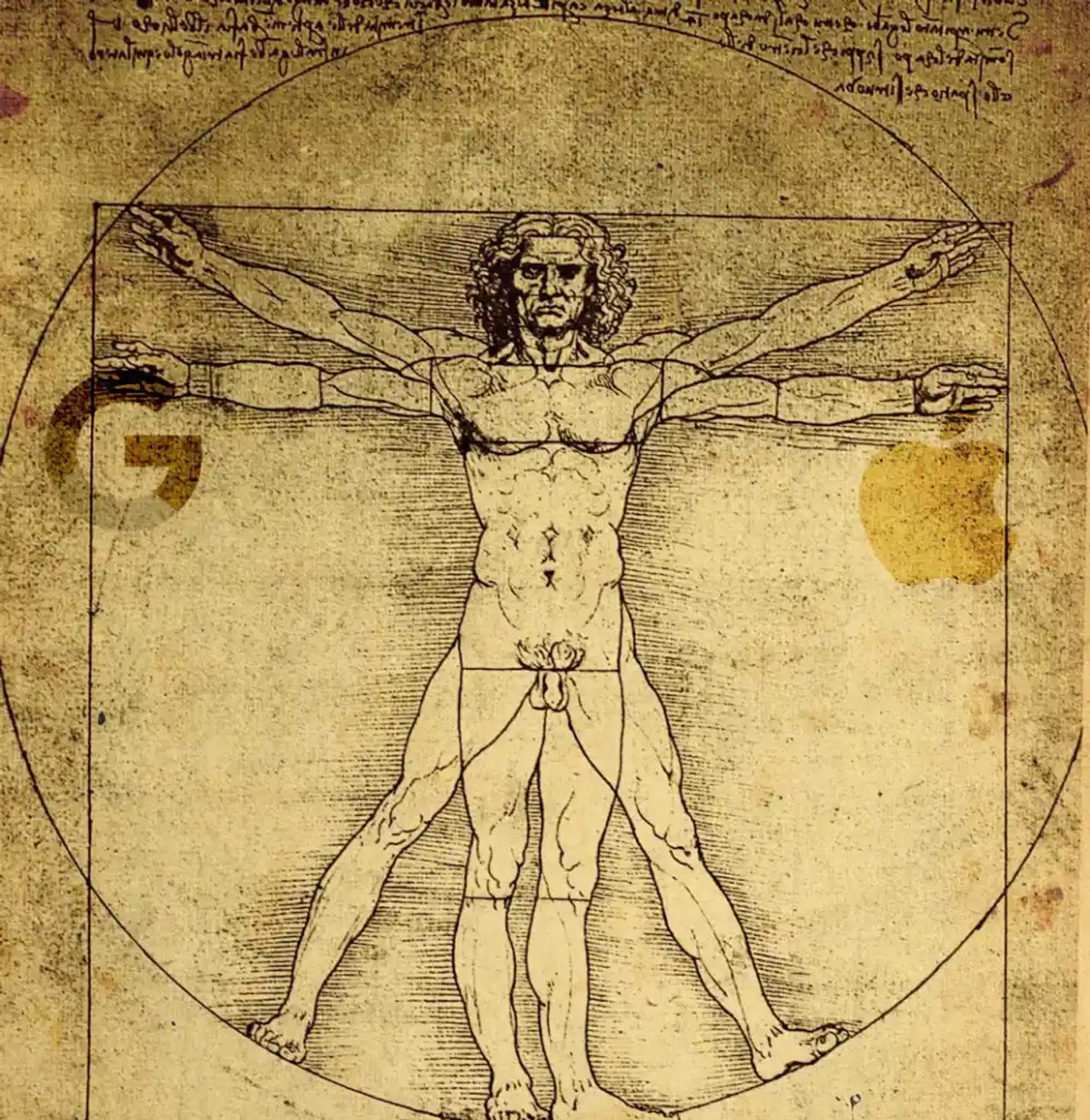
In the early nineties I was a student at Venice Academy of Fine Arts and I had free access to the galleries where the "Vitruvio's man" drawing of Leonardo Da Vinci is preserved. Almost never exposed to the risk of damage, I often went to visit the galleries and I managed to see it sometimes, totally fascinated by this composition and what it represents, as a symbol for human history.
Due to my relationship with this drawing, I felt a bit ashamed to manipulate it for the cover, but please give me the benefit of the purpose. This abuse will have more meaning at the end of this article.
History went through a dark period, the Middle Ages. With Humanism and the Renaissance, a new chapter of human history started, a period in which humanity was the focus of creative activities. This drawing by Leonardo da Vinci put a human body, and its proportion, in the middle of the geometry. Humanity is placed in the middle of the creative activity, as the center of scientific creation and the universe.
And what has this to do with the web? Let me explain from the beginning.
The history of the web itself is very quick. The first website was set live on the 6 august 1991, just in that period when I was admiring Leonardo Da Vinci Vitruvio's man. It is only 30 years since that date but in such a little time the impact of the web on our everyday life is huge, we do not need to mention how revolutionary it is.
Even in this limited time, we can define some kind of eras. We lived the web 1.0 from the very beginning to 2005 more or less, when the web was a sort of static way to browse and look for content, buy books or cheap stuff, but also the possibility of cheap and fast communication: Skype.
Then came web 2.0, when the users started to produce the content, it is the democratic evolution of the web. We thought we had finally the power to freely express ourselves with no limitations right on our keyboards. It is the time of social media, Facebook, Twitter, Instagram, or brilliant ideas like AirBnb, Uber, and so on and so forth.
And now we enter web 3.0. For some not yet begun, for others we are already in. For some, including Tim Bernes-Lee, the creator of that first web site and the inventor of the HTTP protocol, web 3.0 is the semantic web, for others is the age of cryptocurrencies.
There is at least a thin thread these eras have in common: the lack of ethics. The first web was the anarchic period, with no rules, the only rule was that we had to be on the web, even without a plan, just to try to get some outcome out of it, but it is also the period when the contents start to be created and get available for users, the sharing of human acknowledgment. Web 2.0 turn out as the way to convert this apparent freedom to express goods or bad opinions on social media: a trojan horse to exchange opinions with our data.
For a bunch of idealists, including me, web 3.0 should be the chance to put users (as we call the humans been in front of the web) at the focus of the web creations. Since the web was born, the possibility to make money out of the web has been the focus. The democratic gift we received, the ability to create relevant content for the web itself, and the possibility that humanity has to get the advantage of this sharing of knowledge, should become the focus instead.
Social media as Instagram is publicly accused of manipulating teenagers and provoking body shaming or even suicide. Facebook is accused of creating social clashes and instigating violence through the comments of its users. Former employee Frances Haugen reveals documents that show how Facebook prioritizes business before users' health.In the meantime, Facebook change the name to Meta and the case is closed.
If web 3.0 is sold to us as the cryptocurrency revolution and the chance to make the world a better place, more free from capitalism, from the traditional currencies, my impression is that we might face the same that happen with web 2.0, the web might take over users even more.
Now, the web is not made only by designers and developers, there are stakeholders interested, of course, in making a proper outcome out of applications. There are therefore web marketing experts involved to promote and increase that outcome. There are rules, a legislative apparat that tries to regulate this "young" phenomenon, to avoid the web becoming an anarchic territory where everything can happen. And there are users that close the circle, those who are the target of every single application developed for the web.
We already saw the consequences of the re-targeting mechanism between search engines and social media and how users got aware of that explicit manipulation and how such mechanisms have been pushed the audience away from the advertised products.
Isn't that a clear wake-up call, for all involved?
Speaking for myself and my profession, as designers of web applications, we should prioritize ethical choices in front of all mechanisms that treat users as an entity to be glued in front of the screen as much as it is possible. Make them come back to applications as much as possible. Many companies have already abandoned notifications on mobile devices to reduce pressure on their users, which is good in my opinion, a good sign. Put users in the center: not in the same way as we did introduce UCD (user center design), which was an important and crucial step for web development, but it should be more an ethical mindset: ethics in front of profit. Even the most ethical feature of web development: accessibility, was often mixed with the fact that 20% of users can't access functionalities on the web, permanent or temporary, and 20% means less profit for companies, not frustration for those users but still less profit.
I know: that is the story of capitalism... I know! But who has to be sorry if we miss another chance in the history of web. We learned from the Renaissance that humanity has only gained by setting the human in the center.
At the end of the day we should focus, as designers, on making users less addicted to the applications we create. To give the users what they need in the fastest way to give them the opportunity to spend more time off the screen. Where is the overall user experience that makes users spend more time on the screen? In the long run, we are going to lose users, fed up with our applications.
As a user myself I will instead be more and more aware, critical and careful with applications I am going to use and sort better the messages, I will receive from the screen of my devices.
Now I have used the terms "users" so many times that it start to be awkward, especially if I recall the phrase I recently read from Edward Tufte, a computer scientist and a professor emeritus of computer science, political science, and statistics at Yale University: “There are only two industries that call their customers "users": illegal drugs and software” and this phrase is also a good way to condense the thoughts of this article.
If we are going through a dark time of the web, a kind of middle age for the web is not for me to sentence, the web is a powerful and amazing instrument, I am pretty sure Leonardo himself would have loved it. But for sure, nowadays, we can't do anything without the web. Our lives depend on it, our relationships, many of our jobs. And thanks it exists. How would we have dealt with Covid 19 if we had not had the internet? But let us instead use the web to make our real lives easier and spend more time in them, lives where humans are in the center and not tecnology.
Illustration by Carlo Alberto Burato